
This content is for informational purposes only and does not constitute legal advice or create an attorney-client relationship.
When homeowners invest in solar, they’re often sold a vision: lower energy bills, reliable systems, and long-term savings. But for many, the reality looks very different.
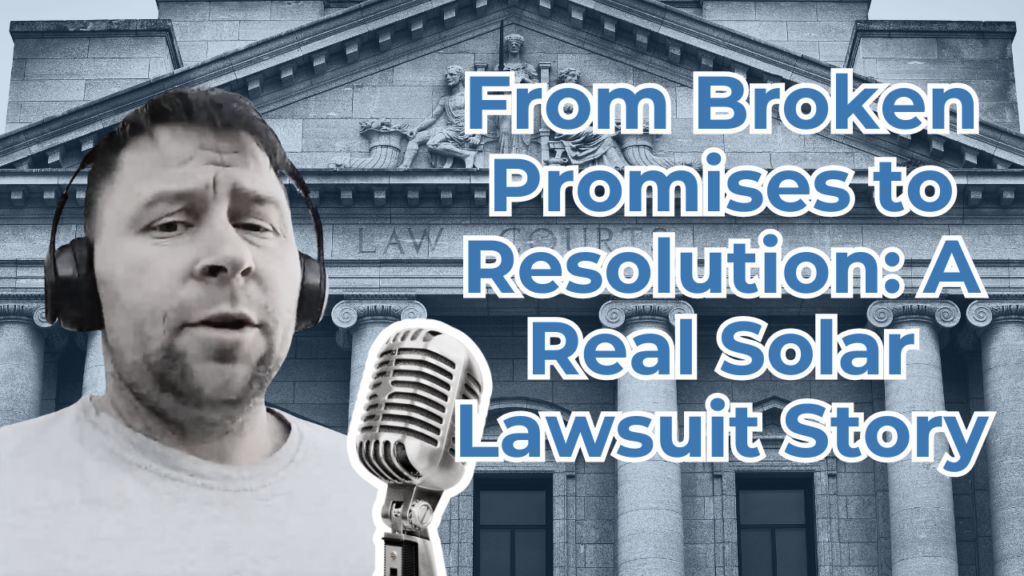
This is the story of one client who found himself stuck with a non-working system, a disappearing installer, and a lender still demanding payment. And how working with Prevost Law Firm helped him reach a resolution.
When Solar Promises Fall Apart
Like many homeowners, Kelly was promised what sounded like a complete, reliable solar setup. That included a functioning system, a battery wall, and long-term warranty protection.
What he got instead was something very different.
After installation, the system never worked. Key components (like the battery) were never delivered. And within just a few months, the installation company disappeared entirely.
That left Kelly in a difficult position:
- Panels were installed but not functioning
- Promised equipment was missing
- The installer was no longer in business
- The lender was still requesting payments
From the lender’s perspective, the loan still existed. From Kelly’s perspective, the contract had not been fulfilled.
Want Help From The Law Firm Solely Focused on Solar Panel Lawsuits?
Click below and complete the form to learn more.

This disconnect is where many solar disputes begin.
The Hidden Risk in Solar Contracts
One of the biggest challenges in solar cases is how contracts are structured.
Many agreements are written in a way that heavily favors the companies involved—especially lenders. Even if something goes wrong with installation or performance, the financing agreement may still be enforceable unless there is a clear breach.
In Kelly’s case, there were multiple issues that pointed to a breach:
- Failure to deliver promised equipment
- A non-functioning system
- Inability to honor the warranty due to the installer’s disappearance
These weren’t minor problems. They went to the core of the agreement.
As Kelly described it, the situation felt like being locked into a contract that was never properly fulfilled.
Why Documentation Matters
One of the most important factors in this case was documentation.
Kelly kept records of his communications, including emails with the lender. In those emails, the lender even acknowledged that certain components—like the battery—were supposed to be part of the contract.
That kind of evidence can be critical.
In solar cases, documentation may include:
- Contracts and agreements
- Emails or written communication
- Photos of installed (or missing) equipment
- Records of system performance issues
Without documentation, it can be much harder to prove what was promised versus what was delivered.
With documentation, the case becomes much clearer.
The Role of the Lender
A common misconception is that disputes are only with the installer.
In reality, lenders often play a central role.
Even if the installer disappears, the loan typically remains. That means homeowners may still be expected to make payments on a system that doesn’t work.
In these cases, legal action often focuses on the lender—especially when the loan is tied to the installer’s performance.
Kelly’s case followed this path.
Rather than pursuing a company that no longer existed, the legal strategy focused on the lender and the contractual obligations tied to the loan.
A Long Process, But a Meaningful Outcome
Solar cases are rarely quick.
Kelly’s case took time: nearly two years from start to finish. Part of that delay came from the lender, who continued to resist and slow the process.
This is not uncommon.
Lenders may:
- Delay responses
- Challenge claims
- Extend negotiations
In some cases, disputes move toward arbitration before a resolution is reached.
That’s exactly what happened here.
The case progressed close to arbitration, with key arguments centered around the failure to deliver what was promised, especially the missing battery and non-working system.
Ultimately, the pressure of the case led to a settlement.
While specific terms remain confidential, Kelly described the outcome simply: it was the best-case scenario for his situation.
Was It Worth It?
When asked whether the process was worth it, Kelly didn’t hesitate.
Yes.
Despite the delays and frustration, reaching a resolution meant no longer being stuck in a contract tied to a system that never worked.
That’s a critical point.
Without legal support, many homeowners feel they have only two options:
- Continue paying for a system that doesn’t work
- Default and face financial consequences
But there may be a third option—challenging the contract itself when there is evidence of a breach.
A Broader Lesson for Homeowners
Kelly’s experience highlights several important takeaways for anyone dealing with solar issues:
1. Not all solar installations go as planned
Even well-marketed systems can fail due to poor installation, missing components, or company closures.
2. Contracts matter, but so does performance
If a company fails to deliver what was promised, that may open the door to legal options.
3. Documentation is critical
Keeping emails, contracts, and records can make a major difference in the outcome of a case.
4. Lenders are often key players
Even if the installer disappears, the lender may still be responsible under certain legal frameworks.
5. Legal support can change the outcome
Without representation, many homeowners feel stuck. With the right support, there may be a path forward.
What to Do If You’re in a Similar Situation
If you’re dealing with a solar system that isn’t working, missing equipment, or a company that has gone out of business, the first step is simple:
Ask questions.
Kelly’s initial consultation was free, and that conversation helped him understand his options.
As he put it, reaching out can’t hurt, but staying stuck in a bad situation can.
If you’re facing issues with your solar system, you may have options.
Getting clarity on your situation could be the first step toward resolving it.
👉 Get a no-cost claim review and find out what’s possible for your case.
This content is for informational purposes only and does not constitute legal advice or create an attorney-client relationship.


