This content is for informational purposes only and does not constitute legal advice or create an attorney-client relationship.
Roof leaking after solar? Learn how to document roof damage after a solar installation and preserve the evidence your lawsuit depends on, step by step.
Last updated: October 12, 2026
This content is for informational purposes only and does not constitute legal advice or create an attorney-client relationship.
The most important evidence in a solar roof-damage case is usually sitting right over your head. And it is often the first thing homeowners pay a roofer to haul away.
A water stain spreads across the ceiling. Shingles near the panels lift. The installer stops answering. Understandably, you want it fixed now. But if you are in a dispute with a solar company or lender, or you expect to be, how you document roof damage after a solar installation might determine whether you can prove what happened.
Want Help From The Law Firm Solely Focused on Solar Panel Lawsuits?
Click below and complete the form to learn more.

The short answer: Photograph and video every sign of damage before anything is touched, get a written inspection report, keep every removed part, export your monitoring data and messages, and tell your attorney before repairs begin. Once a lawsuit is possible or likely, courts in Texas and elsewhere expect you to preserve relevant evidence. Losing it can weaken or even sink your claim.
Below, we walk through what to capture, how to store it, and how to handle urgent repairs without destroying your case.
Why Should You Document Roof Damage After a Solar Installation?
Documenting roof damage after a solar installation matters because causation is usually the whole fight. The solar company will rarely admit its crew caused a leak. Instead, the defense tends to be that your roof was old, a storm did it, or a later roofer made it worse.
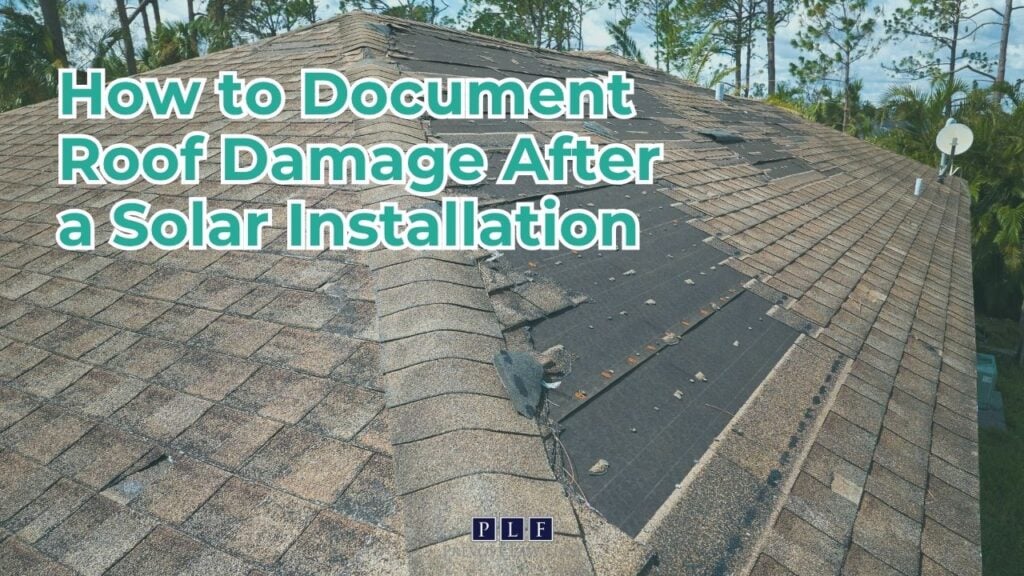
Your documentation could help address those arguments. Roof penetrations, the holes drilled to anchor racking (the metal rails that hold the panels), should be sealed with flashing, a thin metal or rubber barrier that sheds water. When flashing is missing, mis-lapped, or never installed, it could leave physical proof on the roof itself.
The scale of the problem is growing. The Solar Energy Industries Association reports the U.S. passed 6 million solar installations in 2026, with 97% on residential rooftops. That is millions of roofs with new holes in them, many installed by subcontractors who are no longer around.
Tracy’s experience with roof damage after her installer disappeared shows how quickly these situations can leave a homeowner with nowhere to turn.
When Does the Duty to Preserve Evidence Start?
The duty to preserve evidence starts when you know, or reasonably should know, that a claim is likely, not when a lawsuit is filed. Many homeowners assume preservation rules only apply to big companies. They apply to you too.
In Brookshire Brothers, Ltd. v. Aldridge (2014), the Texas Supreme Court set out the modern framework for spoliation. Spoliation means losing, altering, or destroying evidence relevant to a legal dispute. Under that case, a party who had a duty to preserve evidence and failed to take reasonable care to do so can face consequences from the court.
In practice, for a homeowner, the duty can arise earlier than you think. Sending a demand letter, filing a complaint with the Texas Attorney General, contacting a solar lawyer, or simply deciding you plan to hold the installer responsible can all be signs that litigation is reasonably anticipated.
The safest rule: The moment you suspect the solar installation damaged your roof, start treating everything as evidence.
What Could Happen If You Don’t Preserve the Evidence?
If evidence is lost after the duty to preserve arises, a court can sanction the party who lost it, and that includes homeowners. The penalty depends on how the evidence was lost and how much it hurts the other side.
Under Brookshire Brothers, Texas trial judges weigh the spoliating party’s culpability against the prejudice to the opponent. Remedies range from excluding evidence to, in cases of intentional destruction, instructing the jury that the lost evidence may have hurt the party who lost it.
Federal courts follow a similar approach for digital evidence. Federal Rule of Civil Procedure 37(e), amended effective December 1, 2015 allows courts to act when electronically stored information, such as texts, emails, photos, and app data, is lost because a party failed to take reasonable steps to preserve it.
Even without formal sanctions, the practical damage is real. If the original flashing is in a dumpster, your expert has nothing to examine, and the installer’s expert gets to tell the story unopposed.
How Do You Photograph and Video Solar Roof Damage the Right Way?
Photograph the damage before anyone touches it, and capture the image or video so a stranger could understand exactly where each picture was taken. Good roof-damage photos show both context and detail.
Follow this sequence:
- Start wide. Capture the whole house and each roof plane from the ground, so the array’s location is clear.
- Move closer. Photograph each section of panels, the rails, and the roof around them.
- Get the details. Shoot every mount, lag bolt, gap in flashing, cracked shingle, sealant smear, and conduit run, with a coin or tape measure in frame for scale.
- Go inside. Document ceiling stains, wet insulation, attic decking, daylight through nail holes, and mold.
- Record video. Walk slowly through the attic and around the house while narrating the date and what you see.
Do not climb onto a roof yourself. A licensed roofer or a drone operator can capture the rooftop safely, and a professional’s photos often carry more weight.
Never edit, filter, or crop your originals. Make copies for sharing and keep the untouched files with their metadata (the hidden date, time, and location data your phone stores in each image).
What Other Evidence Should You Collect Besides Photos?
Photos prove the damage exists. Documents and data prove when it started and who caused it. Gather everything that connects the damage to the installation date.
Key items to collect:
- Your solar contract, loan documents, and warranties, including any roof-penetration or workmanship warranty.
- City permits and inspection records for the installation, often available from your local building department.
- “Before” evidence of your roof, such as listing photos from Zillow or Realtor.com, Google Earth historical imagery, a prior roof inspection, or homeowner’s insurance inspection photos.
- Installer photos. Lenders frequently require installation photos before releasing payment to the installer, so ask the installer and lender for copies in writing.
- Monitoring data from apps like Enphase Enlighten, SolarEdge, or the Tesla app. Export reports showing installation dates, outages, and production drops.
- Every communication: texts, emails, voicemails, call logs, and warranty tickets.
- Repair estimates, invoices, and receipts, including any detach-and-reset quotes.
What to do when your solar installer stops responding covers how to put warranty requests in writing, so they become part of this record.
Can You Repair Your Roof While a Solar Lawsuit Is Pending?
Yes, you can usually make urgent repairs, but you should document first, notify the other side, and keep what is removed. Courts generally expect homeowners to limit further damage, so leaving an active leak to rot your decking is not the answer either.
The goal is to protect your home without destroying the proof. A typical sequence could look like this:
- Tarp or temporarily seal the leak to stop water intrusion, and photograph the area before and after.
- Get a written inspection from an independent licensed roofer or engineer who notes the cause of the damage.
- Call your attorney before permanent repairs. Your lawyer may want to send written notice to the installer or lender offering a chance to inspect.
- Have the repair crew save and bag removed materials, including flashing, bolts, shingles, and sections of decking.
Permanent repairs often mean removing the panels first. The Journal of Light Construction, a construction trade publication, reports detach-and-reset bills of $3,000 to $5,000, which is a cost worth documenting as damages.
Our guide to hail damage, solar panels, and roof repairs in Texas explains why solar roof repairs often involve several companies at once.
How Should You Store and Organize Your Evidence?
Consider storing evidence in at least two places and keep a simple log of what you have, where it came from, and who has handled it. That log, sometimes called a chain of custody, helps show your evidence has not been altered.
For physical evidence:
- Place removed flashing, bolts, shingles, and decking in labeled bags or boxes.
- Write the date, the location on the roof, and who removed each item.
- Store them somewhere dry, such as a garage shelf, not the curb.
For digital evidence:
- Back up original photos and videos to a computer and a cloud service such as Google Drive, iCloud, or Dropbox.
- Turn off any setting that auto-deletes old texts or compresses photos.
- Screenshot app data and export it as PDF or CSV where possible.
- Keep one folder per category: photos, documents, communications, monitoring, repairs.
Do not post about your case on social media. Defense lawyers routinely search public profiles, and an offhand comment about an “old roof” can become an exhibit.
Quick Reference: Do This, Not That
The simplest way to preserve evidence in a solar roof case is to capture first, change second, and throw away nothing. This table summarizes the most common choices homeowners face.
| Situation | Do this | Avoid this |
|---|---|---|
| Active leak | Tarp it, photograph before and after | Ignoring it or doing a full tear-off first |
| Damaged flashing or bolts | Bag, label, and store removed parts | Letting the roofer haul them away |
| Photos and videos | Keep originals with metadata, back up twice | Editing, filtering, or deleting “bad” shots |
| Installer texts and emails | Export and save everything | Deleting threads or switching phones without backup |
| Monitoring app | Export production and alert history | Letting the account lapse or close |
| Inspection findings | Get them in writing from a licensed pro | Relying on verbal opinions |
| Permanent repairs | Notify your attorney first | Surprise repairs before the other side can inspect |
| Talking about the case | Speak with your attorney | Posting details on Facebook or Nextdoor |
What If the Solar Company Is Out of Business?
You still need to preserve evidence when the installer has closed, because your claim may continue against the lender or another responsible party. A bankrupt installer does not end the case; it often changes who you pursue.
Under the Federal Trade Commission’s Holder Rule, a lender that finances a consumer purchase can be subject to claims and defenses the buyer has against the seller, in many circumstances. That means the same roof evidence may support claims involving your solar loan.
Wood Mackenzie and SEIA have projected a significant contraction in residential solar in 2026, with installer bankruptcies among the reasons. Many homeowners we hear from are dealing with an installer that simply vanished.
Angella’s story of roof leaks after her solar company went out of business and how the Holder Rule can protect solar borrowers show how these cases can still move forward.
FAQs: Documenting Roof Damage After a Solar Installation
Can I fix my roof leak if I’m suing the solar company? Usually yes, especially for urgent temporary repairs like tarping. Before permanent repairs, document everything, get a written inspection, and talk to your attorney, who may give the other side a chance to inspect first. Keep all removed materials, since destroying them could hurt your case.
Do I really have to keep old shingles and flashing? Once a claim is reasonably likely, keeping removed roofing materials is one of the most important steps you can take. Damaged flashing, lag bolts, and rotted decking can show how the installation was done. Bag and label each item with the date and roof location, then store it somewhere dry.
Are photos from my phone good enough evidence? Phone photos are often very useful, especially when they are clear, taken before repairs, and kept as untouched originals with their metadata. Pair them with a professional inspection report and drone or roofer photos of areas you cannot safely reach yourself.
When does my duty to preserve evidence begin? Generally, when you know or reasonably should know a legal claim is likely, which can be well before a lawsuit is filed. Under the Texas Supreme Court’s 2014 Brookshire Brothers v. Aldridge decision, failing to take reasonable care to preserve relevant evidence after that point can lead to court sanctions.
How long do I have to bring a claim for solar roof damage in Texas? Deadlines vary by claim type. Many Texas Deceptive Trade Practices Act claims must generally be brought within two years of when the problem was discovered or reasonably should have been discovered. Because deadlines can be strict, it is wise to speak with an attorney promptly.
Conclusion: Protect Your Roof and Your Case at the Same Time
When a solar installation damages your roof, you are protecting two things at once: your home and your ability to prove what happened. Document before anything changes, keep every removed part and message, and bring in your attorney before permanent repairs.
None of this requires legal expertise. It requires a phone, a few labeled bags, and the discipline not to throw anything away. Those small steps often make the difference between a potential claim and a he-said, she-said dispute.
If you are dealing with roof damage, leaks, or an unresponsive installer after going solar, Prevost Law Firm may be able to help you understand your options. Request your no-cost claim review or call (855) 584-3576.
This content is for informational purposes only and does not constitute legal advice or create an attorney-client relationship.