
This content is for informational purposes only and does not constitute legal advice or create an attorney-client relationship.
Solar Legal Process, Timeline & What Clients Can Expect
If you hire Prevost Law Firm to represent you in a solar dispute, your case will typically move through several stages, beginning with client intake and document collection and potentially continuing through a claim letter, negotiations, arbitration and resolution.
Prevost Law Firm represents homeowners in disputes involving solar installers, lenders and financing companies. Depending on your situation, your case may involve an installer, a solar lender or financing company, or multiple parties.
This guide explains what happens after you hire Prevost Law Firm for solar legal help, what our team does at each stage, what we may need from you, where delays can occur, and how we communicate with you throughout the process.
Every solar case is different. Not every matter follows every step below, and not every case proceeds to arbitration. When arbitration is required, however, the process can take several months or longer depending on factors outside our control, including lender cooperation, arbitration scheduling, discovery, settlement negotiations and the complexity of the claims.
Want Help From The Law Firm Solely Focused on Solar Panel Lawsuits?
Click below and complete the form to learn more.

Many clients ask us, “What happens next?” The truth is that arbitration is a process. It can take several months or sometimes longer depending on lender cooperation. Knowing what to expect makes it easier.
One of the most common questions we receive is,
How long will my solar case take?
Although we can provide an estimated timeline based on our experience, no attorney can guarantee how quickly a case will be resolved. The timing depends on many factors outside our control, including the lender’s cooperation, the complexity of the claims, arbitration scheduling, discovery disputes, settlement negotiations, and whether the case proceeds to a full hearing or later court proceedings.
Some matters resolve within months, while others may take several years. In especially complicated or heavily contested cases, it is possible for the process to last twelve to twenty-four months, or even longer. Be prepared for it to go as long as 24 months or longer if the lender is successful in dragging out the case by the various delay methods listed below.
We believe clients deserve to understand that possibility from the beginning so they can make an informed decision and enter the process with realistic expectations.
Below, we break down each step of the typical arbitration process and explain what it means for you.
What Happens After You Hire Prevost Law Firm? Overview
While every solar dispute is different, the process generally includes:
1. We collect your documents and review your claim.
Our team gathers key documents such as your solar contract, financing agreement, communications and other evidence related to your dispute.
2. We identify the parties and legal issues involved.
Depending on the circumstances, this may include the solar installer, lender or financing company, or multiple parties.
3. We prepare and send a claim letter.
Prevost Law Firm outlines the relevant allegations, legal issues and requested resolution and sends the claim to the appropriate parties.
4. We pursue resolution and, when necessary, arbitration.
Some matters may resolve through negotiation. When the applicable agreement requires arbitration and the matter does not resolve beforehand, the firm may proceed through the arbitration process.
5. We manage the legal process through resolution.
Our team manages deadlines, communications with opposing parties, evidence and other legal steps while keeping the client informed as the case progresses.
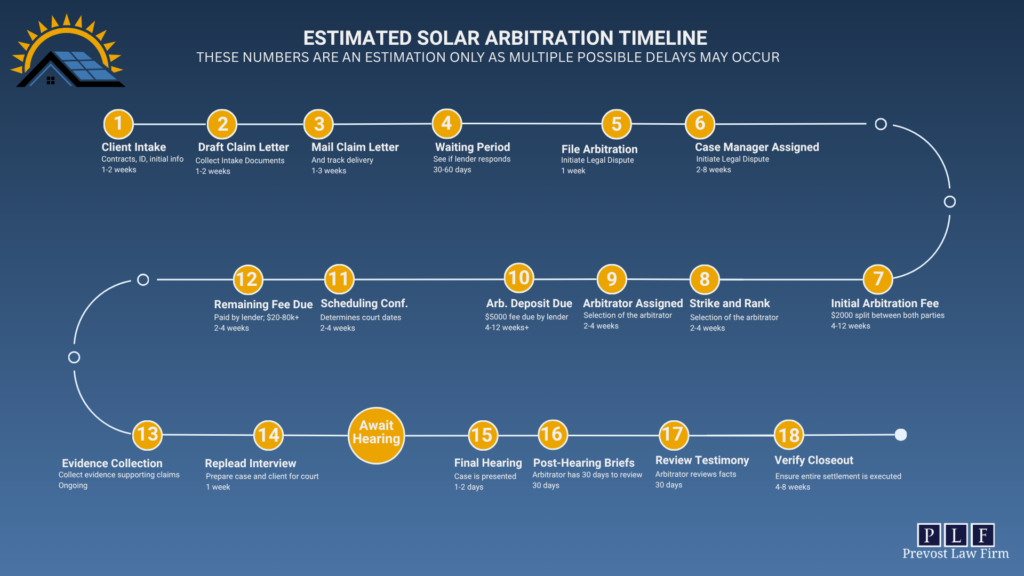
Below is a detailed breakdown of the arbitration process and the potential timing of each stage.
Detailed Timeline
***The below is an estimated timeline that is subject to much variation based on multiple parties and other uncontrollable factors.
1. Client Intake (1-2 Weeks)
This is where your case officially begins in a Prevost Law Firm solar lawsuit. Once you agree in letting us represent you, we ask for (3) key documents. This helps us start your case and begin drafting your demand letter. These include:
- Your loan agreement
- Your solar installation contract
- The completed intake form we send to you
- Your legal form of ID
If your installer is in-business, we may also require:
- Communications from the installer or lender
We use these documents to build the foundation of your claim and identify all legal issues, such as misrepresentation, breach of contract, violations of the Deceptive Trade Practices Act (DTPA) and usage of a fraudulent dealer fee.
Possible Delays: Obtaining contracts may delay your client intake timeline.
What Prevost does: We collect specific documents from you to help qualify your case in preparation for asserting specific claims in your demand letter. The Client Intake Form asks detailed questions about the sales process, state of your system and other personal details to help evaluate claims in preparation for making demands.
What we need from you: Honesty and submitting these documents in a timely fashion are critical. We need your loan contract, your installation contract, your completed intake form that we send during onboarding, your legal form of ID and in some instances, we may need an additional authorization form signed so we can assist in obtaining additional loan information.
Read more about client intake.
2. Drafting the Claim Letter (1-2 Week)
The claim letter is a formal legal notice we send to the lender and/or installer outlining your complaints backed by our legal foundations for the arguments we are making. It includes:
- A description of the promises made (e.g., system savings, tax credits, warranties)
- How those promises were broken (proving breach of contract and DTPA violations)
- What harm this caused you (e.g., financial losses, system failure, lien threats)
- A request for resolution (loan cancellation, refunded payments, lien removal and credit repair.)
This step is legally required before we can initiate arbitration. It also gives the other side a chance to settle early, although that is rare in solar panel cases.
Possible Delays: If the loan holder changes, we will need to re-draft a demand letter to the newest loan holder.
What Prevost does: Once we collect your contracts and intake information, our team begins a detailed assessment of the paperwork. Does your loan and installer contract match? Are there potential unknown loans? Are there any issues with home ownership or loan signers that need to be reevaluated? Do we have relevant claims to assert, or do the case facts need to be reassessed based on information in the Intake Form? Drafting your demand letter is the second time we evaluate your potential claims, the first time being your consultation with our legal assistants.
What we need from you: If contracts do not match, we may move a client from Drafting back to Intake to ensure we have updated documentation. It is not uncommon for us to find discrepancies. Sometimes the discrepancy reveals there is a second loan. We need clients to be honest about who owns the home, and about the sales process, so we can ensure we are asserting accurate claims in the demand letter.
Read more about drafting the claim letter.
3. Mailing the Claim Letter (1-3 Week)
After drafting the claim letter, we mail the letter to all relevant parties.
This triggers a mandatory waiting period required under most arbitration agreements.
It is essentially a final chance for the opposing side to respond or resolve the matter informally. If they fail to act, we move forward.
What Prevost does: Before we mail a demand letter, the information is reviewed once more for accuracy and to check for discrepancies in the intake form and in the contracts. If any unanswered questions are discovered, a client may be moved back to Intake before a letter is mailed to ensure we do not make any errors.
What we need from you: Continue to keep us appraised of your case facts, including old and new information. Examples could include a loan sale, system repairs or deceased loan signer information.
Read more about mailing the claim letter.
4. Waiting Period (30-60 Days)
Once we send the claim letter, we must wait 60 days before filing for arbitration. This is a standard industry practice and gives lenders or installers time to investigate and respond to your claim.
We know waiting is frustrating, but this pause is part of the legal process and necessary to protect your rights. If nothing is resolved by the end of this window (and usually, it is not), we proceed to arbitration.
Possible Delays:
- Letter delivery alone takes 1-3 weeks after mailing. On occasion, letters become lost in transit. We re-mail letters after 3 weeks of non-delivery.
- If the loan sells, we will need to re-draft and re-mail a demand letter to the most current loan holder.
What Prevost does: Before we can ensure we are giving the lender appropriate notice, the first step is ensuring the demand letter is delivered. We track the mailing and delivery so we can begin the 60-day countdown at an appropriate time. Once the letter has been mailed, we continue to move your consultation records to your case file and prepare for your client interview.
What we need from you: If your loan sells during this time, we need to know as soon as possible. When you notice that your statements are coming from a different servicer, please contact us immediately so we can redraft your alleged claims. We also need to know if your loan gets charged off, or if you are served for your solar loan debt due to non-payment and collections. In addition, keeping us informed about system repairs, roof repairs and potential home sales is critical at all stages of your case.
Read more about the 60-day waiting period.
5. Filing for Arbitration (1 Week)
When the lender fails to settle outside of court in 60 days, we officially file your case with a third-party arbitration service like the American Arbitration Association (AAA) or JAMS. Arbitration is a private legal process, similar to a courtroom trial, but typically faster and less formal.
Filing in a Prevost Law Firm solar lawsuit includes submitting:
- A formal demand for arbitration
- A summary of your claims and evidence
- Payment of our filing fee
- Notice to all parties involved
What Prevost does: Before we file an arbitration, we request a current loan statement to ensure your loan has not sold and that we are suing the appropriate party. We will also conduct what is called a Replead Interview. This interview is like a more detailed version f the Client Intake Form, where we verify your case facts to keep things fresh in your mind and make sure your case facts have not changed. The Replead Interview helps prepare our legal team for your Arbitration Replead, a legal document that they must submit.
What we need from you: We need to know if your loan sells right away and will be requesting a loan statement to triple-check before filing. We also need to know the status of your loan payments. Are you current? In collections? Has your loan been “charged-off”? Have you been served? Keeping us informed about system repairs, roof repairs and potential home sales is critical at all stages of your case.
Read more about filing arbitration.
6. Case Manager Assigned (2–4 Weeks)
Once your case is accepted, a case manager is assigned. This person acts like a clerk or administrator and keeps the process on track.
For lenders, the same case manager is assigned every time, which allows us to streamline communications. Your case manager handles paperwork, deadlines, and eventually scheduling, but they do not decide the outcome.
Possible Delays: The arbitration administration must process cases in the order they are assigned. We have previously seen case manager assignments take up to 12 weeks.
What Prevost does: We update your case file all along the way with relevant contacts. Your case manager will now be noted in your file, so we communicate with the appropriate parties. We await the response of opposing counsel and for the case to be commenced by the case manager and upload a series of Commencement Documents to your case file that the case manager sends as part of the initial arbitration proceedings.
What we need from you: Please continue to keep us informed about loan sales, home sales, system repairs or roof repairs as all of these scenarios affect your case and require immediate follow-up actions. Honesty and transparency are important at all stages. If you have failed to reveal important facts that affect your case, our legal team can submit an Amendment to update your filing.
Read more about having a case manager assigned.
7. Initial Arbitration Fee Paid (4–12 Weeks)
After a case manager is assigned, the arbitration provider issues the initial arbitration invoice to both parties. In most consumer solar arbitrations, the lender is responsible for paying the majority of these fees, while the consumer portion is typically limited under applicable arbitration rules.
The initial arbitration fee is generally around $2,000 and must be paid before the case can move forward to the arbitrator selection process. Once the required fees have been received, the arbitration administrator will proceed with the next phase of the case.
Possible Delays: The arbitration process cannot move forward until all required initial fees have been paid. While most lenders ultimately pay these invoices, delays can occur due to administrative processing, disputes regarding payment responsibility, or simple inaction by the opposing party. In some cases, additional legal action may be required to compel participation in the arbitration process, which can extend the timeline by several months.
What Prevost does: The ball can get dropped by multiple parties, so we monitor every aspect of case progression so that everything continues to move forward. We have a team that tracks when the arbitration administration sends the invoice, and when opposing counsel pays the invoice. If there is delay at either one of these stages, we follow-up with the arbitration administration.
What we need from you: Please continue to keep us informed about loan sales, home sales, system repairs or roof repairs as all of these scenarios affect your case and require immediate follow-up actions. Honesty and transparency are important at all stages. If you have failed to reveal important facts that affect your case, our legal team can submit an Amendment to update your filing.
Read more about waiting for the lender to pay the initial fees.
8. Strike and Rank / Arbitrator Selection (2–4 Weeks)
This might sound technical, but the “Strike and Rank,” is simply the process of choosing the arbitrator for your case.
The arbitration service sends both sides a list of potential arbitrators. Each side then “strikes” (removes) any they find unsuitable and ranks the rest in order of preference. This process ensures a neutral decision-maker oversees the case.
Once both parties submit their rankings, the arbitration body assigns an arbitrator/arbitrator to your case.
What Prevost does: The Strike and Rank is a document that our legal team submits. During this process, we are given a list of arbitrators to choose from. We have the opportunity to remove anyone from the list we have chosen not to work with, and we rank the remaining options in an ordered list from most to least preferred. This is based on both our personal experience with individuals and also researched precedents and case examples.
What we need from you: Please continue to send in evidence as it is procured. For example, we will continue to ask for electric bills until your hearing date. In addition, please keep us well informed about anything that could impact your case, or that could be related to your case.
Read more about selection and strike and rank.
9. Arbitrator Assigned (2–4 Weeks)
After the Strike and Rank process, an arbitrator is formally appointed to your case.
This person is usually a retired arbitrator or an experienced attorney trained in arbitration.
They will oversee the case from this point forward, including setting deadlines, reviewing evidence, and ultimately issuing a decision.
What Prevost does: Prevost Law Firm monitors arbitration administration portal messages so we are aware of arbitrator assignment as soon as possible and can meet any requests as soon as possible.
What we need from you: We need to know with certainty what your availability will be, and if any dates are off the table for hearing schedules as soon as possible. Final hearings can take months to schedule, and resetting hearing dates is highly unconventional once scheduling happens.
Read more about having an arbitrator assigned.
10. Arbitrator Deposit Due (4–12 Weeks+)
Once an arbitrator is assigned, the arbitration provider issues an invoice for the arbitrator’s initial deposit. In many consumer solar arbitrations, the lender is responsible for paying the majority of these costs, while the consumer portion is typically limited under applicable arbitration rules.
The arbitrator deposit must be paid before the case can move forward to the scheduling conference and hearing preparation stages. Once payment is received, the arbitrator can begin actively managing the case and establishing deadlines.
Possible Delays: Lenders occasionally delay paying arbitrator invoices, which can significantly slow the progress of a case. The arbitration provider generally will not allow the matter to move forward until the required deposit has been paid. Administrative processing delays, payment disputes, and non-payment by the opposing party can all extend the timeline. Our team closely monitors arbitration invoices and follows up with the arbitration provider and opposing counsel to help keep cases moving forward whenever possible.
What Prevost does: The ball can get dropped by multiple parties, so we monitor every aspect of case progression so that everything continues to move forward. We have a team that tracks when the arbitration administration sends the invoice, and when opposing counsel pays the invoice. If there is delay at either one of these stages, we follow-up with the arbitration administration.
What we need from you: Please continue to send in evidence as it is procured. For example, we will continue to ask for electric bills until your hearing date. In addition, please keep us well informed about anything that could impact your case, or that could be related to your case.
Read more about waiting for the arbitrator deposit to be paid.
11. Scheduling Conference (2–4 Weeks)
Once fees are paid, we attend a scheduling call with the arbitrator and the opposing side. During this conference:
- The arbitrator sets key deadlines for document exchanges and motions
- A hearing date is selected
- Everyone agrees on a general timeline for the case
This is like a kickoff meeting that sets expectations and keeps things moving forward.
Possible Delays: Scheduling expeditiously is dependent on the arbitrator’s availability and the availability of opposing counsel.
What Prevost does: Our scheduling attorney works diligently and tirelessly to fight for a hearing date that occurs as soon as possible. Delay can be costly, and we are sympathetic to the emotional toll of waiting. It is of upmost importance to s that your final hearing occurs as soon as humanly possible once evaluating the schedules of everyone involved.
What we need from you: It is critical that you let us know about any possible unavailability. Once we get a final hearing date, rescheduling can be challenging and could delay your case by several months, perhaps over a year.
Read more about the scheduling conference.
12. Remaining Arbitration Fees Due (2–4 Weeks)
After the scheduling conference is completed and hearing dates are established, the arbitration provider calculates the anticipated remaining costs for the case. These fees are based on factors such as the projected hearing length, the arbitrator’s hourly rate, and the overall complexity of the dispute.
In many consumer solar arbitrations, the lender is responsible for paying the majority of these fees. Depending on the case, the remaining arbitration balance can range from approximately $20,000 to $80,000 or more.
Before the case can move into the final hearing phase, the required deposits generally must be paid to the arbitration provider. Once payment is received, the case can proceed toward preparation and the final hearing.
Possible Delays: Opposing counsel may dispute the amount of the invoice, the lender may delay payment, or the arbitration administrator may require additional time to process deposits and issue confirmations. Because the hearing cannot typically proceed until the required fees have been paid, delays at this stage can impact the overall case timeline.
What Prevost does: The ball can get dropped by multiple parties, so we monitor every aspect of case progression so that everything continues to move forward. We have a team that tracks when the arbitration administration sends the invoice, and when opposing counsel pays the invoice. If there is delay at either one of these stages, we follow-up with the arbitration administration.
What we need from you: Please continue to send in evidence as it is procured. For example, we will continue to ask for electric bills until your hearing date. In addition, please keep us well informed about anything that could impact your case, or that could be related to your case.
Read more about remaining arbitration fees.
13. Evidence Collection (Ongoing)
After the scheduling conference and before the hearing, both sides gather and exchange documents. This process is called “discovery,” and it is where your original documents become incredibly important.
We will work with you to gather:
- Communications with the solar company or lender
- Records of inspections or site surveys
- Electricity bills before and after installation
- Production reports from your monitoring system
- Tax returns (if you were misled about the tax credit)
- Inspection reports or records of installation failures
- Expert opinions or evaluations, if needed
- Anything else that might support your case
We handle the legal legwork here. You just help us gather anything specific to your experience.
What Prevost does: Our case evidence process is so detailed that we have an entire team dedicated solely to this purpose. We countless pieces of evidence, utilize a detailed file-naming format and folder structure, and sort and organize your evidence in an easy-to-follow case file. It can take several days just to sort one case file, or several months dependent on your ability to obtain the requested documents.
What we need from you: We need you to actively participate in your case to obtain the documents we request. We cannot do this portion for you. You will be responsible for obtaining several years’ worth of electric bills, production reports, tax returns and more. Prevost Law Firm continues to ask for ongoing electric bills until the final hearing.
Read more about evidence collection.
14. Pre-hearing Interview (1 Week)
As the hearing approaches, you will meet with your legal team to prepare for the final stage of the arbitration process. This meeting is designed to ensure you understand what to expect and feel comfortable presenting your experience.
During the pre-hearing interview, or replead interview, we will:
- Review the key facts of your case
- Discuss the testimony you may provide during the hearing
- Explain the types of questions you can expect from both sides
- Organize important documents and evidence
- Prepare for potential cross-examination
- Address any questions or concerns you may have about the hearing process
Most clients have never participated in an arbitration hearing before. The goal of this meeting is not to “coach” testimony, but rather to help you feel informed, prepared, and confident when it is time to tell your story. By the end of the interview, you should have a clear understanding of the hearing process and what to expect on the day of the proceeding.
What Prevost does: The interview verifies your case facts once again. We review your contracts, your initial intake form, your replead interview, electric bills, reports and more to make another full evaluation of your case to make sure we got it right and assert accurate claims.
What we need from you: Please continue to keep us informed about loan sales, home sales, system repairs or roof repairs as all of these scenarios affect your case and require immediate follow-up actions. Honesty and transparency are important at all stages. If you have failed to reveal important facts that affect your case, our legal team can submit an Amendment to update your filing.
Await Hearing
After hearing preparation is complete, the parties wait for the hearing date established by the arbitrator. Depending on the arbitrator’s availability, the schedules of the parties involved, and the complexity of the case, this waiting period may last several weeks or, in some cases, several months.
During this time, the legal teams continue preparing for the hearing and addressing any final procedural matters that may arise.
What Prevost does: We continue to organize your file and work on a Production of all of your evidence. This is submitted during the wait for the final hearing. Usually, the wait before the final hearing involves several deadlines for the exchange of evidence bewteen our team and opposing counsel.
What we need from you: Please continue to keep us informed about loan sales, home sales, system repairs or roof repairs as all of these scenarios affect your case and require immediate follow-up actions. Honesty and transparency are important at all stages. If you have failed to reveal important facts that affect your case, our legal team can submit an Amendment to update your filing.
15. Final Hearing (1–2 Days)
The final hearing is the arbitration equivalent of a hearing. During the hearing, both sides have the opportunity to present their evidence, call witnesses, and make legal arguments before the arbitrator.
The hearing may take place virtually or in person, depending on the arbitrator’s preferences and the circumstances of the case. During this stage, witness testimony is presented, documentary evidence is reviewed, and both parties have the opportunity to explain their positions.
After the hearing concludes, the arbitrator will take the matter under consideration and later issue a written decision.
What Prevost does: During the final hearing, our attorneys are ready to fight for your case. They have thoroughly educated themselves on your specific case so that they can use the evidence to generate arguments and call witnesses. They answer arbitrator questions, respond to opposing counsel, argue damages and suggest resolutions.
What we need from you: We need clients to maintain consistency, honesty and integrity. During the Client Interview, make sure you are well informed and confident in your knowledge of your own case facts so that you can prepare for the hearing, mentally and emotionally.
Read more about the final hearing.
16. Post-Hearing Briefing Submissions (30 Days)
After the hearing, both sides are scheduled to submit a post-hearing brief within 30 days. The arbitrator then has 30 days to review the testimony, evidence, exhibits, and legal arguments presented by both sides. During this period, the arbitrator evaluates the facts of the case and determines whether either party is entitled to relief.
Most arbitration providers require arbitrators to issue a written decision within a specified period following the hearing, often around 30 days. No action is typically required from the client during this stage.
Possible Delays: The record generally remains open until all authorized briefs, exhibits, and supplemental submissions have been received. The arbitrator’s 30-day award period may therefore not begin until the final submission deadline or until the arbitrator formally closes the hearing.
What Prevost does: Our legal team reviews the final hearing record and addresses any arguments made by opposing counsel. briefs legal issues that remained unresolved and explains the requested remedy. They may also answer additional questions that the arbitrator has.
What we need from you: Law can be slow, and we appreciate your patience. We are almost at the end and there is nothing else we will need from you at this time.
17. Arbitrator Reviews Testimony (30 Days)
The arbitrator has 30 days to review the testimony, evidence, exhibits, and legal arguments presented by both sides. During this period, the arbitrator evaluates the facts of the case and determines whether either party is entitled to relief.
Most arbitration providers require arbitrators to issue a written decision within a specified period following the hearing, often around 30 days. No action is typically required from the client during this stage.
Depending on the facts of the case, the award may include remedies such as loan cancellation, monetary damages, refunds, credit reporting corrections, or other forms of relief. Arbitration awards are generally final and subject to only limited review by the courts.
Possible Delays: If post-hearing briefs, proposed findings, attorney-fee evidence, or supplemental exhibits remain outstanding, the case may not yet be considered submitted for decision.
What Prevost does: Prevost Law Firm’s trial attorney stays actively engaged rather than treating that period as downtime. The attorney’s job is to make sure the arbitrator is working from an accurate understanding of the record and that the strongest evidence is clearly tied to the relief PLF is requesting.
What we need from you: During that end-of-hearing review period, the client usually has a much narrower role than the attorney. The client should remain attentive, available, and quiet unless the arbitrator or attorney asks for input.
18. Verify Closeout (4–8 Weeks)
After an arbitration award is issued, the parties must complete any required follow-up actions. This may include processing award payments, updating loan balances, correcting credit reporting, executing release documents (like the UCC lien), or implementing other terms of the resolution.
While the case has effectively concluded, administrative processing can take several weeks depending on the lender, servicer, credit bureaus, and other parties involved.
Possible Delays: Payment processing timelines, lender implementation procedures, credit bureau update schedules, and administrative backlogs can all affect how quickly the final resolution is completed.
What Prevost does: We have an entire team dedicated to the execution of any settlement terms or arbitration awards. We do not go away once your hearing is over and the arbitrator has made a ruling. The settlement team continues to monitor for lien removal, credit correction and makes sure that funds are disbursed appropriately. This process can take several weeks, and in some instances over 2 months as we continue to monitor the lien places on your home by the lender.
What we need from you: We will give you information for the credit bureaus and ask you to monitor your credit to verify once the loan has been removed (if you received loan cancellation). We may also ask you to continue to check for your lien depending on your settlement and what state you’re in.
How Prevost Law Firm Communicates With Clients During a Solar Case
Solar disputes can involve periods when the firm is waiting on a lender, opposing counsel, an arbitration administrator or another third party. A lack of movement during those periods does not necessarily mean that nothing is happening with your case.
Prevost Law Firm provides clients with updates as their cases reach important stages, including Client Intake initiation, Drafting, Mailing, Arbitration Filing, Case Manager Assignment, Strike and Rank Process, Arbitrator Assignment and Final Hearing Scheduling.
In addition, we send out regular updates about facts that affect a multitude of clients such as lender updates, bankruptcy filings and negotiation and settlement progression. Our case management team strives to respond to client inquiries within 24–48 hours, and we are always building our team to meet any growing demand in communications to make sure we can meet that standard or exceed it.
When a delay is caused by an outside party, our goal is to explain what we’re waiting for, what happens next and whether anything is currently needed from you.
Conclusion
Arbitration is not always fast, but it is effective. Prevost Law Firm has helped countless homeowners get out of unfair, misleading solar contracts and recover money they thought they would never see again.
We handle the hard parts—fighting delays, pushing lenders, managing deadlines—so you do not have to.
If you are feeling overwhelmed by your solar loan or warranty loss, reach out for your no-cost claim review today.
📞 Call (855) 584-3576 or
📩 Start Your Free Case Review
We are here to fight for justice, and for you.
Here is a summary as well as more detailed pages on most of the 18 steps:
🔍 18 Steps in the Arbitration Process
- Client Intake
- Draft Claim Letter
- Mail Claim Letter
- 60-Day Waiting Period
- File Arbitration
- Case Manager Assigned
- Initial Arbitration Fee Paid
- How the Arbitrator Is Chosen (Strike and Rank Process)
- Arbitrator Assigned
- Arbitration Deposit Due
- Scheduling Conference
- Remaining Arbitration Fees Due
- Evidence Collection
- Pre-Hearing Interview
Await Hearing - Final Hearing
- Post-Hearing Briefs
- Review Testimony
- Settlement or Award Closeout
This content is for informational purposes only and does not constitute legal advice or create an attorney-client relationship.


