This content is for informational purposes only and does not constitute legal advice or create an attorney-client relationship.
You signed a solar contract expecting lower electric bills. Instead, maybe your bill barely changed, the installation was never finished, or the company stopped returning your calls. Meanwhile, the payments keep coming.
If that sounds familiar, you’re not alone.
When these problems can’t be resolved directly with the company, many homeowners start searching for a solar contract cancellation lawyer to understand their rights.
Whether you can cancel or challenge a solar contract depends on the contract, the facts, and the law that applies. This article explains when that may be possible, which laws may help, and how an attorney can review your options.

Solar Contract Dispute Snapshot
Although every situation is unique, residential solar disputes often involve one or more of the following:
- Alleged misrepresentations during the sales process
- Installation delays or incomplete work
- Equipment that does not perform as represented
- Financing terms that differ from what the homeowner expected
- Difficulty obtaining warranty service or repairs
- An installer that stopped responding or went out of business
- UCC filings or other financing documents connected to the property
- Contract terms that were not fully understood before signing
Not every concern creates legal grounds to cancel a contract, but each of these situations may be worth having an attorney review.
Understanding How Solar Contract Disputes Develop
Residential solar projects often involve several different companies rather than a single provider. Depending on the installation, a homeowner may work with:
- A sales organization
- An installation contractor
- A financing company
- An equipment manufacturer
- A warranty provider
- A maintenance company
Because several parties may be involved, determining who is legally responsible for a particular problem can be more complicated than many homeowners expect.
Installer problems don’t automatically cancel your financing. The installation contract and the loan are usually separate agreements, so a problem with one doesn’t automatically end the other. Depending on the facts, though, you may be able to take legal action against your solar lender. Depending on how the transaction was structured and the contract language involved, the FTC Holder Rule may allow certain claims or defenses related to the seller’s conduct to be asserted against a holder of the financing agreement. That question often comes up when a solar company goes out of business.
How you paid for the system matters too. A solar loan, a lease, and a power purchase agreement (PPA) have different ownership, payment, and transfer terms. So the options for getting out of each can look very different. If you financed the solar system that is at the center of your dispute, our homeowner’s guide to solar lender problems may help.
When Can a Solar Contract Be Challenged?
Whether you can cancel a solar contract or legally challenge it depends on the specific facts, the contract itself, and applicable state and federal law. An attorney may evaluate issues such as:
- Alleged fraudulent or misleading sales practices
- Material breaches of contract
- Failure to complete the agreed installation
- Failure to provide promised products or services
- Warranty disputes
- Potential violations of consumer protection laws
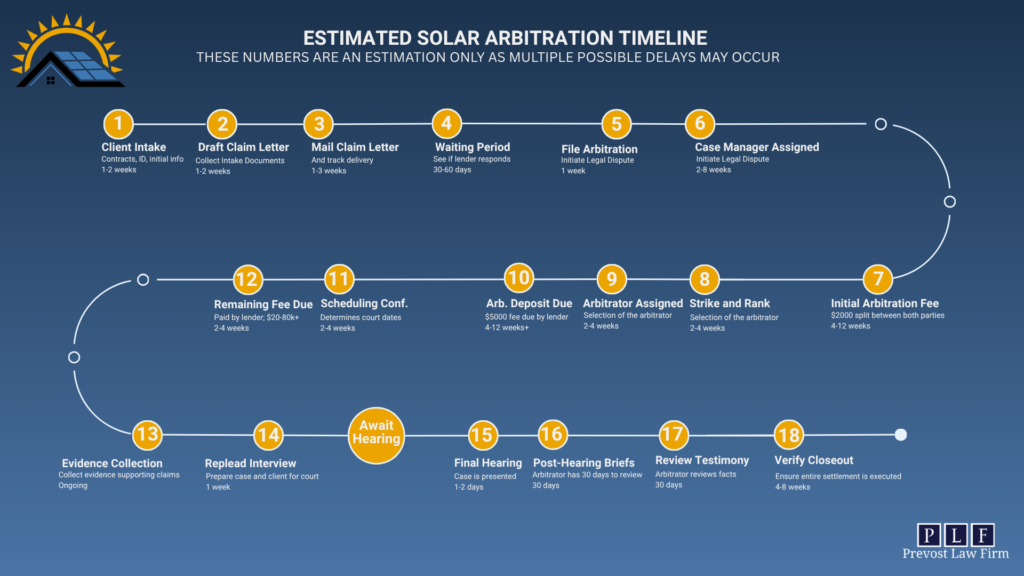
Many solar financing agreements also contain arbitration provisions that may require disputes to proceed through individual arbitration rather than court. If your case goes that route, here’s what to expect at an arbitration hearing.
Timing matters as well. Deadlines for solar claims vary by state and by type of claim, and when the clock starts can depend on when the problem was discovered. Waiting too long could limit the options available to you.
Consumer Protection Laws May Apply
Several consumer protection laws exist to help address unfair or deceptive business practices. Depending on the circumstances, homeowners may have rights relating to:
- Misleading advertising — Ads that give customers the wrong idea about the price, savings, or benefits.
- Inaccurate sales representations — Incorrect claims or promises made during the sales process.
- Financing disclosures — Information about the loan, such as the interest rate, fees, and payment terms.
- Contract violations — When one side fails to do what it agreed to in the contract.
- Certain cancellation rights provided under applicable law — The right to cancel an agreement in certain situations, often within a set time.
The FTC Cooling-Off Rule
The Federal Trade Commission’s Cooling-Off Rule generally gives consumers three business days to cancel certain qualifying sales made at their home or at a seller’s temporary location, such as a convention center or fairground.
The rule has exceptions and does not automatically apply to every residential solar contract.
Texas’s Five-Business-Day Right to Cancel
Texas now has its own solar-specific protections. Under the Residential Solar Retailer Regulatory Act (Texas Occupations Code Chapter 1806, passed as Senate Bill 1036), residential solar sale and lease agreements signed on or after September 1, 2025, must include a five-business-day right to cancel, along with certain required contract provisions and disclosures. The law does not apply to contracts signed before that date, and certain transactions are excluded.
Learn more about your legal rights in a Texas solar panel lawsuit.
Other states have their own consumer protection and home-solicitation laws, and these laws vary by jurisdiction.
What If the Cancellation Window Has Passed?
Most homeowners looking for a lawyer are well past these short cancellation windows. That doesn’t necessarily mean they’re out of options. Depending on the facts, claims based on alleged misrepresentation, breach of contract, or consumer protection violations may still be available.
How a Solar Contract Cancellation Lawyer May Help
A solar attorney looks at the whole picture: what you were told during the sale, the installation contract, the loan or lease, and how the system is actually performing. At Prevost Law Firm, that starts with a no-cost claim review of your contract, loan documents, and situation. From there, the process generally includes:
- Collecting your documents and reviewing what was represented during the sale
- Evaluating potential claims against the installer, lender, or other parties
- Sending a claim letter or taking other appropriate action
- Working toward a resolution, which may happen through settlement, arbitration, or another path
Cases may resolve at different stages, and timing varies. Depending on the facts and applicable law, potential outcomes may include a loan reduction or cancellation, refunds, removal of UCC filings, or other relief. Every case is different, and prior results do not guarantee a similar outcome.
You can read how Jerry found relief after an unfinished solar installation or browse more client success stories.
If we take your case, you’ll know upfront what the retainer covers and how fees work. Here’s a closer look at what it costs to hire Prevost Law Firm for a solar case.
Whoever you talk to, ask who will actually handle your case and whether they’re a licensed attorney. These questions to ask before you hire a solar claim company can help. And be cautious of anyone who promises cancellation up front. No one can honestly guarantee that result, which is why solar panel cancellation guarantees are a red flag.
What Should Homeowners Do If Problems Arise?
Start your paper trail now. If you believe there may be a problem with your solar agreement, keeping organized records can be extremely valuable. Helpful documentation may include:
- The signed contract — Including any signed addenda.
- Financing, loan, or lease agreements and statements — Showing payment terms and balances.
- Warranty documents — Showing what’s covered and for how long.
- Sales brochures, proposals, or advertisements — Showing promised savings or benefits.
- Emails and text messages — With the seller, installer, or lender.
- Utility bills before and after installation — Showing changes in usage and costs.
- Photos of the installation — Showing the equipment and workmanship.
- Inspection reports — Including any issues inspectors found.
- Service requests and repair records — Showing reported problems and repair attempts.
These records may help clarify what occurred if a legal dispute develops. If your roof was affected, here’s how to document roof damage after a solar installation.
Before refinancing a disputed solar loan, consider having the proposed transaction reviewed by an attorney. Refinancing may affect existing claims or defenses and could result in the debt being secured differently.
Lessons for Homeowners
Solar energy can be a good investment when systems are installed properly and contracts are fully understood. If you’re considering solar, or helping a friend or family member who is, it may help to:
- Read the entire contract and ask questions about financing terms before signing
- Understand what the warranty covers and which company provides it
- Request copies of every document
- Take time to compare multiple proposals, and walk away from high-pressure sales situations
Frequently Asked Questions
Can I cancel my solar contract after installation?
Possibly. Short cancellation windows, like the FTC’s three-business-day Cooling-Off Rule or Texas’s five-business-day right to cancel for qualifying contracts, generally expire soon after signing. After that, your options depend on the contract terms, the facts of your case, and applicable state and federal law. Claims based on alleged misrepresentation, breach of contract, or consumer protection violations may still be available.
Is canceling a solar lease different from canceling a solar loan?
Yes. With a loan, you generally own the system and owe a lender. With a lease or PPA, a company typically owns the system and you pay to use it or the power it produces. Those differences affect what options may be available, so it helps to know which type of agreement you signed.
What if my system is not producing the amount of electricity I was promised?
Performance issues can have several causes. A sales projection is not automatically a contractual guarantee, so it helps to compare what your contract says with what you were told. Reviewing your contract, warranty documents, and installation records may help determine whether contractual or legal remedies may be available.
Do verbal promises matter if the written contract says something different?
Written contracts generally control the agreement, although verbal statements may be relevant in certain legal disputes depending on the circumstances and applicable law. That’s one reason to keep brochures, texts, and emails from the sale.
Should I stop making payments if I have a dispute?
Whether to continue making payments is an individual decision. Stopping payments may result in negative credit reporting, collection activity, or other consequences under the loan agreement, potentially including acceleration of the balance. Continuing payments may avoid some of those consequences while a dispute is pending. Talk with an attorney before deciding, and read more about whether to keep paying your solar loan.
When should I contact a solar contract cancellation lawyer?
If you believe you were misled during the sales process, the installation was not completed as agreed, or the company has not fulfilled its contractual obligations, an attorney can evaluate your situation and explain your legal options. Because claim deadlines vary, it’s generally better not to wait. You can start with a no-cost claim review.
Moving Forward
Problems with a residential solar system can be frustrating, especially when the payments keep coming for a system that isn’t doing what you were told it would. You don’t have to sort through the contracts alone.
Whether the issue involves installation concerns, financing questions, warranty disputes, or possible contract violations, understanding your rights is an important first step. Prevost Law Firm handles disputes involving solar installers, lenders, financing companies, and related parties. We’ll review your situation and help you understand the options that may fit your circumstances.
This content is for informational purposes only and does not constitute legal advice or create an attorney-client relationship.
References
- Federal Trade Commission – Cooling-Off Rule
- Federal Trade Commission – Buyer’s Remorse: The FTC’s Cooling-Off Rule May Help
- Texas Department of Licensing and Regulation – Residential Solar Retailers: What’s in Effect When
- Texas Occupations Code Chapter 1806 – Residential Solar Retailer Regulatory Act
- Consumer Financial Protection Bureau
- U.S. Department of Energy – Homeowner’s Guide to Going Solar
- National Consumer Law Center – Consumer Rights Resources
This content is for informational purposes only and does not constitute legal advice or create an attorney-client relationship.