This content is for informational purposes only and does not constitute legal advice or create an attorney-client relationship.
Searching for solar panel lawyers near me has become a necessity for thousands of homeowners.
In Texas alone, more than 50% of consumer complaints to the state attorney general involved homeowners still paying for solar systems that were unfinished, faulty, or never worked as intended. Another 28% of complainants reported systems producing much less power than promised.
Looking at financing practices nationally, 58% of solar projects in 2023 were paid for through loans. These financed systems often come with hidden dealer fees, inflated loan principals, and confusing terms, increasing financial burden even when systems underperform or fail.
If you’re dealing with a solar panel scam or non-functioning equipment, finding the right solar attorney can make all the difference.
The installation of solar panels may sound simple on the surface, but when legal issues arise, they often span multiple areas of law, ranging from consumer protection to real estate litigation and commercial transactions. Because solar power systems are installed on residential property and financed like large commercial assets, these cases frequently involve overlapping energy law and contract law principles.
Want Help From The Law Firm Solely Focused on Solar Panel Lawsuits?
Click below and complete the form to learn more.

An attorney experienced in civil litigation and energy efficiency contracts can provide the level of legal advice required to navigate disputes that cross between homeownership and business financing. For example, solar panel contracts often include arbitration clauses or jurisdiction requirements referencing federal courts or state-specific consumer rights statutes. An experienced legal team understands how to interpret these clauses and use them to your advantage.
Prevost Law Firm’s background in numerous cases involving solar panel fraud, deceptive marketing tactics, and breach of contract allows the firm to move quickly through the legal process while protecting the attorney-client privilege every step of the way.
Understanding these intersections helps you identify the right type of attorney. While many real estate lawyers or general counsel can assist with traditional property disputes, only a firm deeply familiar with solar energy contracts and consumer protection litigation can deliver the specialized legal solutions homeowners need to recover financial losses from failed solar projects.
Experienced solar lawyers near me may help recover damages including loan payments, excess energy costs, repair expenses, and even legal fees. However, not all legal professionals have experience with these cases. Before hiring a solar panel attorney, it’s important to ask specific questions that will help determine if they have the skills needed for your situation.
In this guide, we’ll walk you through essential questions to ask before hiring legal representation for your solar panel issues. These questions will help ensure you find a knowledgeable advocate who can effectively fight for your rights and financial recovery.
#1: How long have you been practicing as a solar attorney?
Experience is the first question you should ask about when seeking solar panel lawyers near me.
Years of experience in law in general, and also specifically solar law
Most qualified solar attorneys possess years of experience practicing law. Ideal solar panel lawyers near me are exceptional consumer protection attorneys and also have experience in solar panel litigation. They also maintain an active law license in good standing, with no disciplinary actions or sanctions on their record.
Relevant certifications or bar memberships
A legitimate solar attorney must hold an active license to practice law. Moreover, they should demonstrate strong knowledge of federal and state regulations governing renewable energy.
Why longevity matters in litigation
Seasoned solar lawyers bring experience in consumer protection law, especially concerning breach of contract, fraud, and deceptive trade practices. Additionally, they possess the skills to represent clients in legal disputes.
How long Prevost Law Firm has been practicing
Neal Prevost brings over three decades of legal experience, advocating for consumers since 1993. After discovering widespread solar industry issues, he transformed his practice to focus exclusively on solar panel lawsuits.
Subsequently, Prevost Law Firm is handling thousands of cases across almost every state in the U.S., making them potentially America’s largest solar-focused firm.
#2: Can you help if my solar company went bankrupt?
One of the most common challenges homeowners face is when their solar installer shuts down, leaving them with non-working systems, voided warranties, and ongoing loan payments.
Whether the company formally files for bankruptcy or simply disappears, the impact can be devastating for families who expected decades of energy savings.
Legal Implications of Installers Going Out of Business
When an installer closes its doors, warranties are often void and service agreements end abruptly. In some cases, a bankruptcy filing may follow, but in many others the company simply vanishes without notice. Either way, homeowners are still left with the burden of expensive monthly loan payments, even when the system fails to perform as promised.
Steps a Solar Panel Attorney Can Take
An experienced solar attorney like Prevost Law Firm can step in to pursue relief through arbitration or litigation. We frequently use consumer protection laws, including the FTC Holder Rule, which holds lenders accountable for the misconduct of the original seller. In many cases, this approach can lead to loan reduction or complete cancellation, even if the installer is no longer in business to face claims directly.
Examples of Cases We’ve Handled
Prevost Law Firm has represented thousands of homeowners across the country whose installers went out of business. In one case, we obtained full cancellation of a $73,590 solar loan plus a refund of $28,493 in payments the client had already made. These results demonstrate that legal remedies remain available even when the installer disappears.
Why Prevost Law Firm?
Unlike general practice firms, Prevost Law Firm focuses exclusively on solar panel litigation. This experience means we understand the unique challenges homeowners face when installers shut down, and we know exactly how to hold lenders accountable so you aren’t left paying for a broken promise.
#3: What should I know about solar panel financing and hidden fees?
Hidden costs lurk behind most solar panel financing agreements, often increasing your total costs significantly without your knowledge.
Understanding solar loan structures
Most residential solar projects cost approximately $25,000 before incentives, and in 2023 around 58% were financed through loans. These loans may come with fixed terms and quoted APRs, but those APRs do not reflect embedded dealer fees. Indeed, solar loans often include dealer fees (effectively finance charges) ranging from 20% to 40% (and occasionally higher) of the cash price.
These fees increase the loan principal, meaning total financed costs can exceed $40,000 once interest is added – far above the “headline” APR.
Hidden fees and deceptive practices
The most concerning aspect is dealer fees. These are markups that inflate loan costs by 30% or more above cash price. For instance, a $30,000 solar system might actually cost you $39,000 after a $9,000 dealer fee gets added to your principal. Additionally, many companies misrepresent tax credits, claiming you’ll receive the 30% federal credit regardless of your tax situation. Afterwards, if you don’t qualify, you’ll face substantially higher monthly payments.
How solar panel lawyers near me can review financing
A qualified solar attorney can thoroughly analyze your contracts for undisclosed fees, tax credit misrepresentations, and violations of consumer protection laws. Specifically, they’ll examine whether your financing agreement violates the Truth in Lending Act or FTC Holder Rule.
Prevost Law Firm wrote an article exposing the real cost of solar
Prevost Law Firm published comprehensive research revealing how dealer fees function as kickbacks, significantly increasing the loan amount without homeowners realizing it.
Learn more about the real cost of solar.
#4: Do you work with clients who were misled about tax credits?
Tax credit misrepresentations rank among the most common complaints we see from solar customers seeking legal help.
Common tax credit misconceptions
The federal solar tax credit (ITC) frequently becomes a source of confusion. Primarily, many homeowners don’t realize it’s a non-refundable credit that only reduces existing tax liability. Not a rebate or cash payment. Second, eligibility requirements often get glossed over during sales presentations. Third, solar companies sometimes encourage claiming non-qualifying expenses like roof repairs under the tax credit. Finally, some installers promote fictitious credits altogether, such as “sovereign tribal tax credits” that the IRS doesn’t recognize.
Legal recourse for misleading tax claims
If you’ve been misled about tax credits, you typically have several legal options. First, claims for fraudulent inducement can be filed when a company intentionally misrepresented tax benefits to secure your signature. Additionally, you might pursue negligent misrepresentation cases even without proving malicious intent. Furthermore, state consumer protection laws often provide powerful remedies against deceptive solar sales practices.
How a solar attorney can help recover losses
A knowledgeable solar lawyer like Prevost Law Firm helps evaluate your contract. Essentially, they’ll identify which laws were violated and calculate your financial damages.
Then the lawyers at Prevost Law Firm pursue canceling your solar loan obligation, getting your payments returned, and recovering attorney fees.
#5: What’s your process for evaluating a potential solar panel case?
When consulting with a solar panel lawyer near me, understanding their case evaluation process helps determine if they’re the right fit for your situation.
Make sure they do a free case review
A reputable solar attorney like Prevost Law Firm should offer a complimentary initial consultation to assess your case. Notably, this allows you to understand your legal options without financial commitment.
At Prevost Law Firm, we provide thorough no-cost case reviews for all potential clients.
Initial case review steps, Documents and evidence needed
First, prepare your complete solar contract, including all addendums and financing agreements. Likewise, gather communications with the solar company, performance data, and payment records. Above all, document any specific promises made during the sales process that weren’t fulfilled.
Timeline for legal action
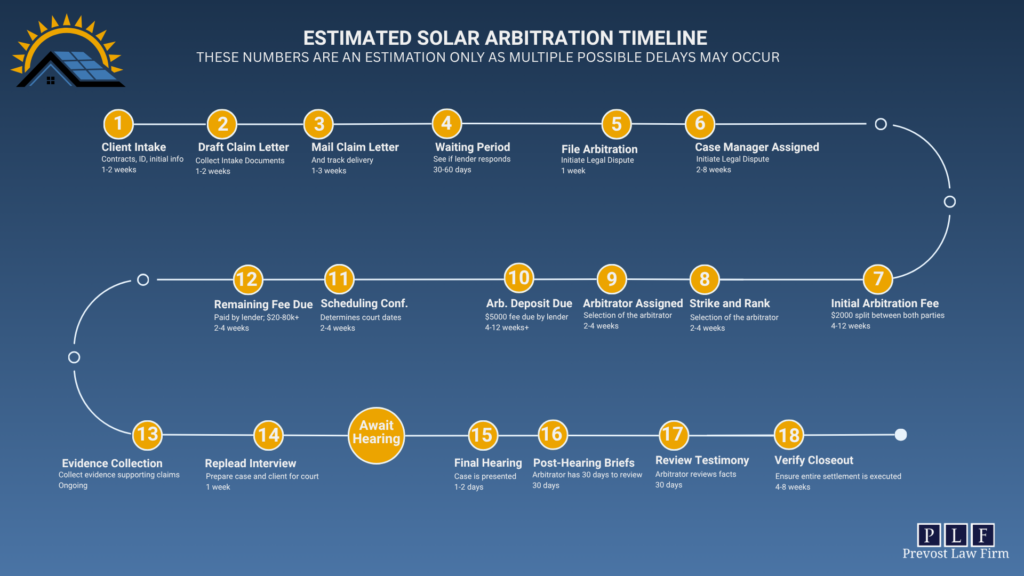
The legal timeline varies depending on case complexity. Typically, after document submission, expect 1-2 weeks for initial evaluation, followed by a consultation to discuss options. Albeit straightforward cases might resolve in 3-6 months, most litigation could extend to 10-18 months.
Prevost Law Firm arbitration process
Instead of lengthy courtroom battles, we primarily resolve cases through arbitration, a faster, more efficient process. We also highly value the attorney-client relationship and prioritize communication and transparency throughout the process. Neal Prevost handled 4,000 cases in his legal career before focusing the firm’s practice area solely on solar lawsuits.
This approach typically results in quicker settlements while maintaining the same legal protections as traditional litigation.
Choosing the Best Solar Panel Lawyer for Legal Support
When choosing among the best lawyers near me for solar panel issues with solar panel companies, it’s important to look for those with decades of experience handling consumer law. Solar projects often involve joint ventures between installers, financiers, and equipment manufacturers. When these relationships fail, the result can resemble a corporate dispute, requiring a firm capable of analyzing fine print, identifying responsible parties, and pursuing remedies across multiple jurisdictions. These broader perspectives allow the attorney to craft more comprehensive recovery strategies and anticipate hidden legal risks that other firms might overlook.
Prevost Law Firm’s legal team and legal services combines extensive experience in consumer protection, energy law, and commercial litigation. This offers clients a level of representation rarely found in traditional law practice areas. Whether your solar contract affects your home value, business tax filings, or future energy savings, their focused yet diverse experience ensures your legal needs are met with precision and compassion.
Conclusion
Finding the right legal representation and years experience for your solar panel issues requires thorough research and asking meaningful questions. Knowing how to identify a qualified solar attorney provides critical protection from further financial harm.
Asking about experience specifically in solar law helps ensure your attorney understands the unique complexities of renewable energy contracts and regulations. Furthermore, a knowledgeable solar lawyer provides valuable assistance when your installer declares bankruptcy, potentially saving you from paying for equipment that no longer functions.
Hidden fees represent another critical area where legal experience proves invaluable. A qualified attorney examines your financing structure and identifies dealer fees or misrepresentations that might have increased your costs by 30% or more. Similarly, legal professionals familiar with tax credit misrepresentations can help recover losses when solar companies made false promises about financial benefits.
The case evaluation process also reveals much about a solar attorney’s approach. Free consultations, thorough document reviews, and clear timelines demonstrate professionalism and client-focused service. Certainly, understanding how your case might proceed through arbitration rather than lengthy court battles helps set realistic expectations.
Remember that finding “solar panel lawyers near me” means more than geographic convenience. It means locating an advocate with knowledge from experience who can effectively fight for your rights.
Though solar panel issues might seem overwhelming, partnering with the right attorney significantly improves your chances of financial recovery and justice. Armed with these eight essential questions, you now possess the tools to find legal representation truly qualified to handle your solar panel case.
FAQs on solar panel lawyers near me
Q1. What experience should I look for in a solar panel lawyer? Look for an attorney with at least 4-5 years of general law practice and specific experience in solar law. They should have an active license, relevant certifications, and demonstrate knowledge of renewable energy regulations.
Q2. How can a solar attorney help if my solar company went bankrupt? A qualified solar lawyer can help you file bankruptcy court claims, pursue relief under the FTC Holder Rule to potentially reduce or cancel your loan, and explore options for recovering damages or maintaining your system’s functionality.
Q3. What are some hidden costs in solar panel financing I should be aware of? Be cautious of dealer fees that can markup costs by 30% or more, misleading APR disclosures, and misrepresentations about tax credits. A solar attorney can review your financing agreement to uncover these hidden costs.
Q4. What legal options do I have if I was misled about solar tax credits? You may be able to pursue claims for fraudulent inducement or negligent misrepresentation. Many state consumer protection laws also provide remedies against deceptive solar sales practices. A solar attorney can help calculate your damages and seek appropriate compensation.
Q5. What should I expect during a solar panel case evaluation? A reputable solar attorney should offer a free initial consultation. Be prepared to provide your complete solar contract, communications with the company, performance data, and payment records. The evaluation process typically takes 1-2 weeks, with case resolution ranging from 3-18 months depending on complexity
This content is for informational purposes only and does not constitute legal advice or create an attorney-client relationship.