This content is for informational purposes only and does not constitute legal advice or create an attorney-client relationship.
Millions of Americans have been duped into one-sided solar contracts, and finding reliable help through a solar cancellation resource center like Prevost Law Firm has become critical for trapped homeowners. Hidden dealer fees ranging from 10% to 30% (and sometimes over 50%), misleading savings projections, and unclear contract terms leave many paying both a solar loan and their utility bill.
In fact, specialized firms like Prevost Law Firm have achieved remarkable results. In one case, solar attorneys canceled a $73,590 loan and secured a $28,493 refund for a homeowner.
Whether you’re researching solar cancellation resource center reviews, wondering if a solar cancellation resource center legit, or exploring options like Prevost Law Firm solar loan cancellation, we’ll walk you through how these resources work and help you determine the best path to exit your problematic solar contract.
Understanding Why Solar Deals Go Bad
Hidden Costs and Misleading Promises
Solar companies frequently misrepresent costs and savings to close deals. Annual price escalators buried in lease and PPA contracts increase monthly payments each year, supposedly reflecting utility rate increases. Cancellation fees trap homeowners who need to exit agreements early. In reality, promised savings often turn into financial disasters. One Vivint Solar customer was promised 20-30% savings but saw their bill increase by 80% the first month and 100% the second month. Another SolarCity customer was repeatedly told their maximum monthly charge would be $76.63, only to discover an additional $75 monthly charge to prepay an Oregon tax credit.
Want Help From The Law Firm Solely Focused on Solar Panel Lawsuits?
Click below and complete the form to learn more.

Companies have also exaggerated tax credit availability. According to state attorneys general, solar firms told consumers they were automatically eligible for tax credits when they weren’t, and when customers tried to exit these contracts, companies threatened them with lawsuits and exorbitant termination fees.
Orphaned Systems from Bankrupt Installers
The wave of solar company closures has created thousands of “solar orphans.” The abrupt Titan Solar bankruptcy affected over 150,000 customers across 22 states. When installers like Pink Energy, Solcius Solar, and ADT Solar filed for bankruptcy, homeowners lost all labor warranty support, monitoring portal access, and service contacts. Solar panels are designed to last 25 years, but without the installer, workmanship warranties become void. Most local solar contractors refuse to service systems they didn’t install, viewing third-party work as a liability.
UCC-1 Liens and Property Complications
Financed solar systems often come with UCC-1 liens filed against the equipment. These filings give lenders security interest in the panels, but they frequently block home sales and refinancing. Buyers must either qualify with the leasing company or sellers must pay off the balance before closing. Some solar companies file UCC-1 statements only when properties go on the market, meaning liens may not appear in initial title searches.
The Double Bill Trap
Community solar subscribers receive two separate bills: one from their utility company and another from the solar provider. In dual billing arrangements, 90% of savings go back to the solar company while subscribers keep only 10%. This creates confusion as homeowners must calculate their own savings between multiple statements, often discovering they’re paying more than expected.
Solar Cancellation Resources
Are Solar Cancellation Resource Centers Legit?
If you’ve been researching help for a solar issue, you may have come across a company called Solar Cancellation Resource Center (SCRC). This is a specific organization that markets itself as a resource for homeowners dealing with solar contracts.
SCRC is not a law firm and does not provide legal advice. Instead, it acts as a National Intake Partner, processing inquiries from hundreds of consumers monthly. The organization collects and organizes documentation for review by partnering attorneys. This administrative hub approach provides a bridge between frustrated consumers and specialized legal professionals who handle litigation or rescission.
At the same time, the phrase “solar cancellation resource center” is also used more broadly to describe companies that operate in a similar way, acting as intermediaries between homeowners and law firms.
Why This Matters
This distinction matters, both for SCRC and companies acting as resource centers.
Many of these companies, including those using this type of model, are not law firms. Instead, they typically function as intake or marketing organizations. They collect your information, organize your documents, and then pass your case along to a separate law firm for legal work.
That means you may not be working directly with the attorneys handling your case from the beginning.
With solar cancellation resource centers, communication and accountability can sometimes become unclear. Because one company gathers your information and another handles the legal work, it can be harder to track progress or get direct answers.
Working directly with a law firm like Prevost Law Firm helps avoid that issue.
You benefit from:
- Clear communication with the legal team handling your case
- Consistent strategy from intake through resolution
- Focused experience in solar-related consumer protection cases
- No unnecessary middle layers between you and your attorney
- High level of accountability and integrity between their marketing and what they can actually do
Because Prevost Law Firm is a law firm handling its own marketing (and not a marketing company partnered with a law firm) it is held to a much higher standard in what it can and cannot say publicly.
Legal advertising is regulated. That means the firm cannot make exaggerated promises or use misleading claims.
With a law firm, the information you see is grounded in what attorneys are ethically allowed to communicate, which helps create a more accurate and trustworthy picture of what to expect.
With a marketing company partnered with a law firm, the messaging is not held to the same legal advertising standards, which can lead to broader claims, less clarity, and a disconnect between what is promised upfront and what the legal process might realistically deliver.
A More Direct Approach: Prevost Law Firm
Prevost Law Firm takes a different approach.
Instead of acting as a middleman, Prevost provides direct legal representation. When you contact the firm, you are working with a legal team that is actively involved in:
- Evaluating your case
- Identifying legal claims against the lender
- Preparing demand letters
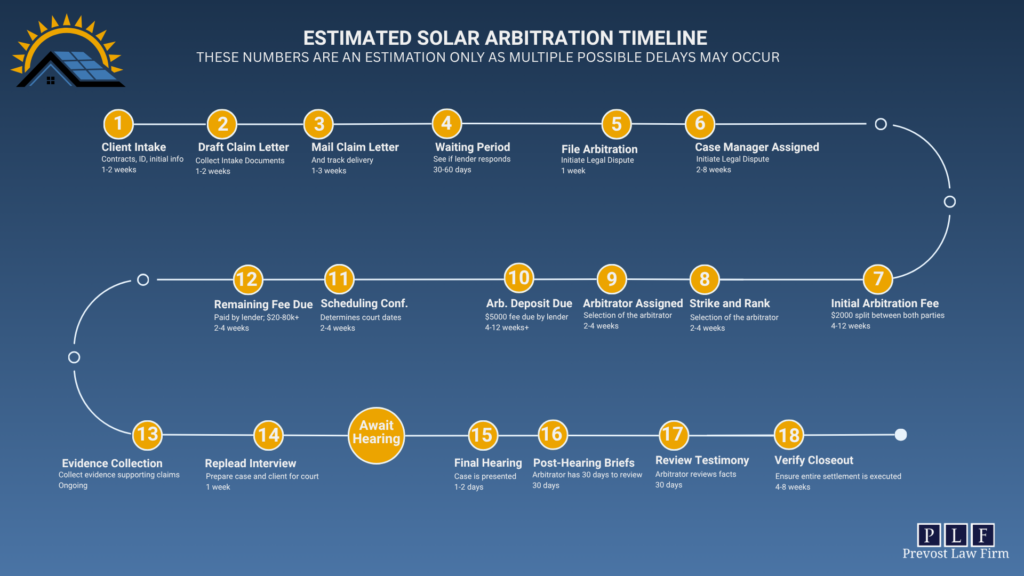
- Filing and managing arbitration
There is no separate intake company or third-party handoff. This creates a more streamlined process and ensures your case is handled by the same team from start to finish.
How Firms Help Homeowners Exit Solar Contracts
Documentation Review Process
Gathering every piece of paperwork forms the foundation of any solar cancellation case. Collect your signed contract and all addendums, financing or lease agreements, copies of marketing materials or sales presentations, and emails or text messages with the salesperson. These documents prove what was promised versus what was delivered. Sales brochures with exaggerated savings claims or emails promising no penalties for early exit can be game-changers in a legal review.
Request written confirmation from your solar company regarding buyout prices, transfer terms, or exit options. Avoid relying on verbal promises, as they’re unlikely to be honored.
Forensic Production Audit
Professional forensic audit reports identify dealer fee stacking, TILA violations, and financial harm using NREL engineering data and federal regulatory analysis. These 39-page reports analyze hidden dealer fees, effective APR, cost per watt analysis, real solar production data from PVWatts v8 with site-specific irradiance modeling, TILA Regulation Z analysis, rescission timelines, state UDAP violations, and Investment Tax Credit fraud risk assessment.
Work with Experienced Solar Attorneys
Only licensed attorneys can review contracts and provide actual legal guidance. Law firms carry weight that solar companies cannot ignore, often leading to quicker, more respectful resolutions. Attorneys spot hidden clauses that strengthen exit cases, help frame requests without waiving rights, and negotiate directly with companies.
What to Expect During the Cancellation Process
Attorneys thoroughly review solar contracts to identify violations and legal leverage points. They develop customized legal strategies based on consumer protection laws and specific circumstances, then negotiate with the solar company or take legal action to cancel, modify, or exit contracts.
SCRC Versus Working Directly with a Law Firm
Beware of solar cancellation services that promise easy exits but have no legal authority. Many cancellation companies charge fees but cannot legally help, often advising stopping payments which damages credit and leads to lawsuits. Licensed attorneys can actually take legal action and represent homeowners in court.
Prevost Law Firm Solar Loan Cancelation
Direct Legal Representation for Solar Disputes
Prevost Law Firm focuses exclusively on helping homeowners take legal action against solar companies and lenders. Founded by attorney Neal Prevost, who has practiced since 1993 with over 4,000 cases and a 98% win rate, the firm currently handles 472+ active solar cases. Unlike advocacy centers, Prevost charges a retainer because solar cases don’t involve guaranteed insurance payouts. Consequently, clients receive direct attorney representation throughout the entire process.
The firm identifies deceptive clauses, hidden fees, and predatory terms in contracts. Legal strategies include canceling or reducing loans for warranty loss, removing solar liens from properties, and recovering payments already made. Under state deceptive trade practices acts, qualifying cases can result in up to triple damages.
Success Stories and Case Results
In one remarkable case, Prevost Law Firm canceled a $73,590 loan and secured a $28,493 refund. Client Daniel’s case took approximately 15 months from start to finish, matching the firm’s initial timeline estimates. Meanwhile, client Natalie’s arbitration case resulted in a confidential settlement after 15 months, eliminating her loan entirely.
When to Choose a Law Firm vs. Advocacy Center
Law firms carry direct legal authority that advocacy centers lack. Solar companies cannot ignore licensed attorneys who can file lawsuits and represent clients in arbitration.
Conclusion
Right now, you have access to legitimate resources that can help you exit unfair solar contracts. As shown above, professional legal teams have canceled loans worth tens of thousands of dollars and recovered substantial refunds for homeowners.
Therefore, don’t stay trapped in a bad solar deal. Request a free case review, gather your documentation, and connect with experienced attorneys who specialize in solar contract disputes. Your path to freedom from predatory solar agreements starts today.
This content is for informational purposes only and does not constitute legal advice or create an attorney-client relationship.